
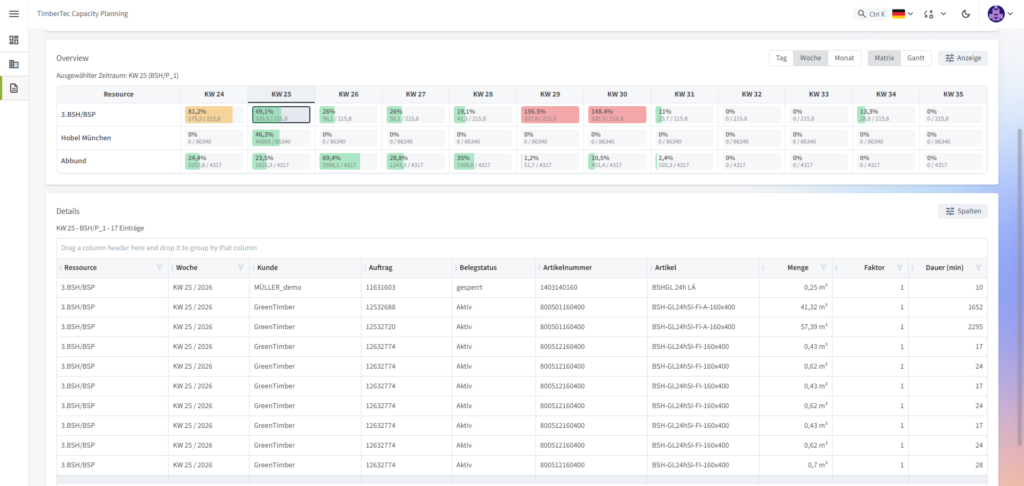
With sales capacity planning, the sales, internal operations, and plant planning teams can see at a glance which capacities are available and which are already allocated. This allows for more realistic planning of delivery dates, early identification of bottlenecks, and reliable scheduling of orders based on a shared database. The web-based solution is directly integrated into TiCom and clearly compares existing order and quote data with available production capacity.
Transparency for Reliable Order Planning
In sales, delivery dates are often set based on past experience, customer requirements, or last-minute coordination. At the same time, detailed capacity information is often not available until orders have already been released for production. This results in a short decision-making window, a high level of coordination effort, and the risk that additional orders will overload capacity or jeopardize already scheduled delivery dates.
Sales capacity planning makes capacity visible earlier in the sales process. Quotes and orders can be incorporated into capacity planning, allowing sales representatives to assess delivery dates based on available capacity. This creates a shared database for sales, back-office staff, and plant planning.
Sales and Production Based on a Shared Database
Sales and capacity planning provides transparency regarding available production capacity and compares it with planned orders. The web-based application displays the respective resources or machines along with their utilization rates over various time periods. It can show both the percentage utilization and the occupied and available capacity. This allows sales representatives to immediately see when capacity is available for an additional order. For example, when a customer makes an inquiry, you can check whether a specific quantity can still be produced in a desired calendar week. Based on this, a realistic delivery date can be included in the quote right from the start.
- Web-Based Capacity Overview: Capacity planning is available as a web application within TiCom and provides a centralized overview of the utilization of the resources on file.
- Overview by Day, Week, and Month: Capacities can be viewed on a daily, weekly, or monthly basis, depending on planning needs. Longer-term planning across quarters is also possible.
- Graphical representation of capacity utilization: Capacity utilization is clearly displayed for each resource, including both used and available capacity.
- Filter by Document Status: Quotes and orders can be specifically included in or excluded from capacity planning based on their status.
- Plant- and resource-based analysis: Capacities can be analyzed separately by production plant or branch.
- Detailed view of capacity allocation: By selecting a capacity cell, you can view the underlying orders and order lines. This makes it easy to see what is occupying a particular capacity.
- Direct Access to Orders: You can navigate directly from capacity planning to the corresponding orders. If, for example, a delivery date changes, the plan can be adjusted accordingly.
- Custom Capacity Factors: Factors can be adjusted for individual orders if, for example, a product requires more production time than specified in the standard settings due to its characteristics.
- Accounting for different units of capacity: Depending on the resource, capacity can be expressed in cubic meters or linear meters, for example.
Three Arguments for Reliable Capacity Planning

Shared database: Sales, internal operations, and plant planning all work with the same capacity information.

Identify bottlenecks early: Overloads and capacity shortages become apparent before they turn into acute problems.

Planning Realistic Delivery Dates: Delivery dates can be assessed and planned more realistically based on actual capacity.

Experience Sales Capacity Planning Firsthand
Would you like to see how sales and capacity planning can be used in your TiCom system? We’d be happy to show you the solution in a personalized demo and, based on your specific needs, demonstrate how capacities can be presented transparently, delivery dates planned more realistically, and bottlenecks identified early on.