Published in *Holzkurier*, Issue 05: CLT , on December 11, 2025. Text and images by Günther Jauck, TimberTec, and Schilliger.
A holistic ERP system ensures transparency, predictability, and customer value
Schilliger’s Volgelsheim facility in France has evolved into a fully digitally supported production network in which TimberTec’s TiCom ERP system links all process steps. From roundwood logistics through the sawmill to KVH and CLT, TiCom now serves as the central information and control hub. The close integration of all areas enables robust production planning, shorter lead times, and reliable customer information.
Schilliger acquired the French facility in Volgelsheim in 2009. The TiCom solution originally implemented by Klenk was not only retained but systematically expanded. “We expanded TiCom step by
—first for production and sales, and later for plant control, sawmill work planning, and the sales module,” says site manager Guillaume Wermelinger. With the latest
expansion, the system now covers the entire value chain from roundwood intake to the delivery of finished glulam products.
The latest development focuses on work planning for glulam and CLT. In the future, roundwood procurement processes will also be fully integrated into TiCom. This creates a comprehensive system that seamlessly connects contracts, logistics, goods receipt, and production planning. TimberTec Sales Area Manager Eric Zink emphasizes: “Our solutions grow with our customers’ needs. Thanks to our many years of experience in the cross-laminated timber sector and our close collaboration with machine manufacturers, we are able to reliably manage interfaces.”

Site Manager, Schilliger Volgelsheim
“Without a good ERP system, there is no transparency and no reliable long-term planning.
With TiCom, we manage the entire process
from start to finish.”
Interview with Guillaume Wermelinger
In the video, Guillaume Wermelinger, Managing Director of Schilliger Bois Volgelsheim, discusses the role of the TiCom ERP system within the Schilliger Group
From importing CAD files to creating labels with QR codes
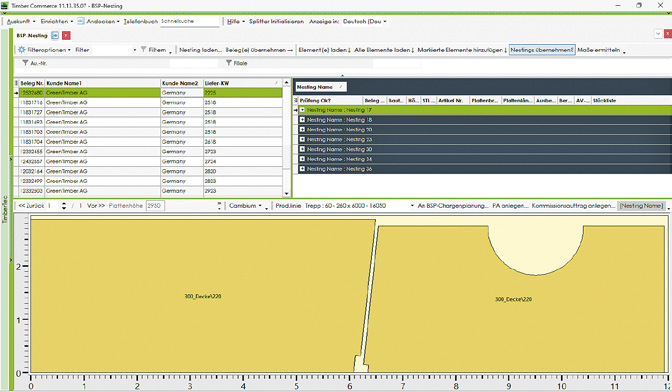
The key advantage for Schilliger lies in the end-to-end data chain. The CAD files for the projects form the basis for CLT. The BSPN module visualizes the nesting process. Additionally, optimization can be performed across projects, a practice that has proven effective for individual components. “What makes the import special is the clear billing to the end customer, because billing is based on the master panel required to manufacture the components,” explains Zink. Batch planning groups panels of identical length or thickness, thereby reducing setup times. In the production order, TiCom calculates the complete lamella structure and transfers the data to the Ledinek master computer.
With quality sorting, the stock can be pre-sorted on one side while simultaneously feeding the finger-jointing line. “The ability to process pre-sorted timber as a batch timber the system flexible,” explains Wermelinger. TimberTec plans the sorting job for the Ledinek system and provides the data via the TimberTec Rest API (TIAS). The sorting order specifies which sawn timber is to be produced using which sorting program. “We take order status into account to ensure high availability of the sorted lamellas,” says Zink.
The finished components are labeled with a QR code. Each scan assigns the component package the correct package . The delivery note can only be generated once the package is package . This step in the process improves traceability and prevents discrepancies.
Reliable delivery dates
In Volgelsheim, Schilliger produces sawn timber, CLT, KVH, and the newly developed building product CL-Therm, which includes thermal insulation. TiCom provides planning certainty, especially for short-notice orders. “The system shows me which master panels I need, what the raw material availability looks like, and which dimensions are in stock,” explains
Wermelinger. Production thus follows a pull-based material flow, in which demand and inventory are precisely aligned. At the same time, reliable delivery dates become possible. “When we give a date, we stick to it,” emphasizes Wermelinger. “We can precisely schedule the truck for the construction site, thereby achieving significant cost optimization in logistics as well.”
Interview with Xavier Fritz
In the video, Xavier Fritz, CLT Coordinator at Schilliger Bois Volgelsheim, explains how the TiCom ERP system supports daily operations, from production planning and timber framing to logistics and shipping.
Customer benefits from connected systems
Schilliger continues its digital integration: The sites in France and Switzerland are now operating on a unified system. This gives the sales team a global overview—from roundwood procurement to the finished product. “Our customers expect transparency and, increasingly, ready-made solutions,” says Wermelinger.
“TiCom enables us to produce custom-made products and provide order status updates at any time.”
TimberTec is constantly introducing new features. Zink points to the technical sales and product support teams: “Our teams come from sawmills and glulam plants themselves. We know what our customers need.” Workshops, process analyses, and training sessions—such as those on the joinery control station—complement the implementation and help the management team become more proficient in using the system.
For Schilliger, TiCom is therefore not just an ERP system, but a key management tool. “Without a good ERP system, there is no transparency and no reliable long-term planning,” says Wermelinger. “With TiCom, we manage the entire process from start to finish.”
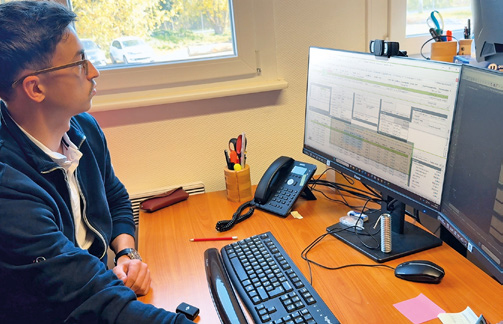
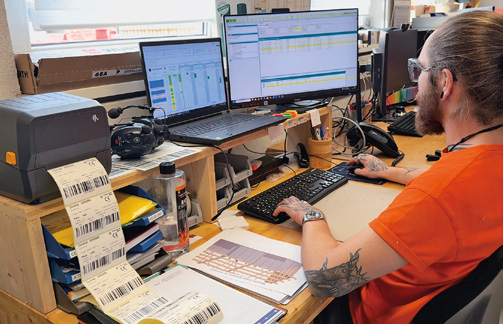
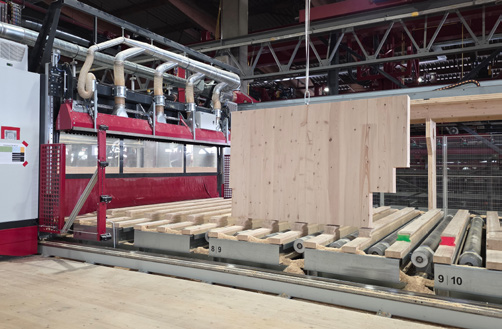
“In addition, TiCom can also integrate the cutting process. Although this optimization feature is not yet in use at Schilliger, it is already being discussed. With the TIAS modules for plant control, the loop could then be closed—from the production order through the master panel and the cutting process all the way to the shipping label,” explains Zink.
The Volgelsheim facility demonstrates how digital integration works in the timber industry: An ERP system that connects all production and administrative areas creates transparency, predictable processes, and stable supply chains. For Schilliger, this translates to a higher level of service, more efficient operations, and better utilization of raw materials—benefits that directly benefit the customer.