
AI is intended to automate administrative tasks and optimize production processes
Published in *Holzkurier*, Issue 39: Follow-up Report on the Klagenfurt Wood Fair on September 24, 2026. Text and photos by Günther Jauk & TimberTec.
TimberTec, based in Eutin, Germany, is evolving from an ERP provider into a digitalization platform for the wood industry. At the International Wood Fair in Klagenfurt, the company showcased, among other things, an AI application that can capture even handwritten bills of materials and use them to create complete orders.
“The trade show in Klagenfurt is one of our most important events,” emphasized TimberTec Managing Director Marcus Wieser. The company’s trade show presentation focused on its strategic journey. “We are continuing to evolve from a traditional ERP provider into a provider of a digitalization platform for the wood industry,” Wieser explained.
The core system of the TiCom ERP system, which maps business and production processes in the wood industry and is supplemented by specialized applications. TimberTec aims to use it to link data from various areas and automate additional processes.
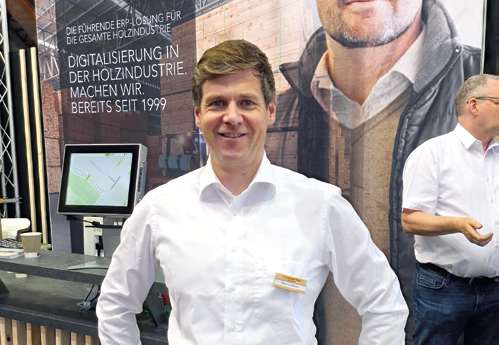
TimberTec CEO Marcus Wieser is presenting new, practical AI solutions at the Holzmesse trade show in Klagenfurt.
From a Note to an Order
One of the main focuses at the trade show in Klagenfurt was on AI solutions for sales and administration. The new TiCom Multiagent collects order information from various sources and converts it into structured ERP data. According to Wieser, it doesn’t matter whether customers submit orders as PDFs, Excel files, or emails; TiCom can automatically generate an order from them.
The system is even supposed to be able to process handwritten notes. “In initial tests, we achieved a match rate of over 70% for handwritten lists,” Wieser reported. When an employee takes a photo of an order list with a smartphone, the system reads the information and prepares the quote or order.
As a next step, TimberTec plans to implement voice input. Field sales representatives will be able to dictate orders directly into their smartphones. Speech-to-text technology organizes the information for TiCom. If a customer has not yet been created in the system, the system can automatically create a prospect. In the long term, this should allow the quote generation process to be largely automated.
Another AI application uses a chatbot to analyze customer data. Employees can, for example, check sales trends, distributions, or the top-spending customers without having to create their own reports.
Focus on Administration
Wieser now sees the greatest need for digitization outside of production. “The wood industry is highly automated and digitized in terms of manufacturing. There is still potential, above all, in management and administration.” AI is intended to reduce routine tasks and shorten processing times.
In the long term, every user—whether working in the office or on the go—should be able to interact easily with ERP processes. AI can convert orders and bills of materials directly into ERP orders.
After sales and administration, TimberTec plans to make greater use of AI in production planning. Wieser cites, among other things, the optimization of press scheduling and packages. “We’re working through the processes step by step. The key is that the customer derives a direct benefit from it. It shouldn’t just be labeled ‘AI’—we want to create a pragmatic solution that actually offers added value.”
TimberTec is also expanding its platform beyond the core ERP system. With TiYard, the company demonstrated an application for the digital log yard. It notifies machine operators when sorting bins are full and assigns them to the designated log pile using GPS and geofencing. This is intended to reduce empty runs and loading times. TimberTec aims to increasingly map out processes—from administration and sales to log logistics and production—on a single platform.

TiYard displays fill levels, loading and unloading, and vehicles in real time, thereby preventing empty trips and the mixing of materials in the stockpiles.
